Tuesday, January 15, 2013

A Focus on Translation: Nzime and Badwe'e


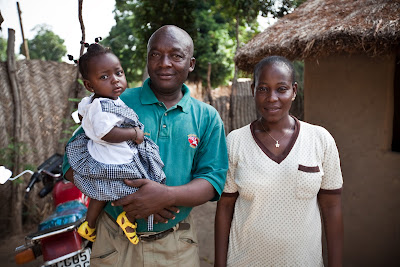
We would like to introduce you to Keith and Mary Beavon. The Beavons came to Cameroon in January of 1976, and began working with the Nzime people. They moved into the home of Joseph Azabor (who later joined them in their translation work) and began learning the Nzime language. As they put it in a recent newsletter:
Joseph Azabor
"In 1976, Mary, Virginia [their daughter] and I began living with the Nzime people, sharing the roof and food of one family. We also exposed ourselves to their language and worldview, learning it in part. It also meant that some of them have had the opportunity to learn ours and maybe God’s, too. (We aren’t sure the two are identical.) Their way of access to the worldview of God is the translation that was our shared passion over many years."

At the Nzime Dedication
After almost 25 years of work among the Nzime people, the translation of the New Testament was completed and dedicated to the Nzime people in 2000.

During their time working on the Nzime language, the Beavons realized that there were many languages that were closely related to Nzime, and they discovered that some of these could use the Nzime translation as a starting point for their own translations.  One of these languages is Badwe'e, a language they came into close contact with when they moved, in 1981, to accommodate their growing family (at this point, they had been blessed with two sons, David and Garth), into the home of the Yangyang family, who were Badwe'e speakers. When the Nzime translation was dedicated, they began working on a translation for the Badwe'e. This New Testament was dedicated to the people in 2003.

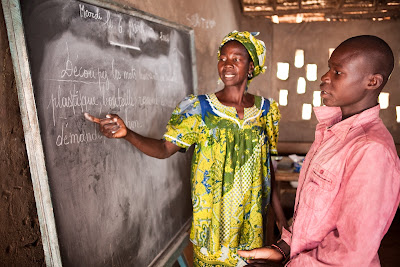
Several others assisted them in their work among these two language groups. Mo Perin, from England, worked with them for a time, and they were also assisted by several Cameroonian colleagues: Joseph Azabor and Joseph Mbong with the Nzime; and Samuel Mpiale and 'Janvier' Ekoalea with the Badwe'e, to name a few.
Janvier Ekoalea teaching a Badwe'e literacy class

The Beavons are continuing their work among these people groups. They have worked on producing an audio copy of the Nzime New Testament as well as a catechism that is currently being used by parts of the Presbyterian church. They are also progressing on the translation of some parts of the Old  Testament into Nzime. They have also been working on Old Testament portions for the Badwe'e, and have been asked by Badwe'e believers for a catechism as well.

But there are other language groups that the Beavons long to serve as well, particularly the Njyem, another language related to Nzime. They began the process of learning Njyem in January of 2001, but were largely unable to live among the Njyem people, which has hindered their ability to effectively minister to this people group. Their hope is to soon be able to move into the Njyem area, living in the truck camper that was their home once their children had graduated from high school and returned to the United States.

We first met the Beavons when we arrived in Cameroon in 1993. When Kevin began teaching at RFIS, Mary was a member of the school board and their two sons were both students, David in 12th grade and Garth in 9th. Both of their boys were in Kevin's English classroom, and Garth participated in several of the plays that Kevin directed while he was a student.

Please pray for the Beavon family as they seek to find ways to effectively continue their ministry to the Njyem speakers. Also pray that the Nzime and Badwe'e Scriptures would be powerful and effective in transforming the lives of believers in those language groups.
The Nzime and Badwe'e New Testaments

Friday, January 4, 2013

A Focus on Translation: Introduction

A selection of several of "our" New Testaments from Cameroon
Some time ago, we decided it would be fun to figure out how many New Testament translations had been dedicated in Cameroon by translators whose children Kevin had taught at RFIS. We hoped to gather a copy of each of these translations, so that we could have a concrete record of the impact that our ministry has had over the years.

It turns out that, since our arrival in Cameroon in August of 1993, we have directly supported the completion of New Testaments in eleven different languages. If that sounds like a rather small number to you, stay tuned to this space; over the next several weeks, we'll be sharing some of the stories behind those eleven translations, which will help put into perspective for you the years of effort that has been put into finishing each of those translation projects.

To put all this in another way, our ministry has helped to bring God's Word to 985,000 people in the languages of their hearts. And there are more to come; some other New Testaments which we have directly supported are nearing completion or are awaiting publication, so that number will soon climb to more than 1 million people who now have free access to and understanding of God's Word who didn't when we began our work in Cameroon almost 20 years ago.

We were very encouraged by all this, and we wanted to give you an opportunity to "get to know" these languages groups that have been impacted by our ministry over the years. So, over the course of the next several weeks, we will be posting blog entries that focus on each of these language groups, sharing the stories of the people and the family that worked on the translation project. Hopefully, this will give you a better sense of what each of these books means to the people group that received it. And we hope, as well, that you will be encouraged, just as we were, to hear of all that God has accomplished through your faithful support of our ministry in Cameroon.

To whet your appetite a bit, here is the complete list (roughly in alphabetical order) of the New Testaments that have been (or soon will be) dedicated in Cameroon by families whose children Kevin has taught:

Akoose - Robert and Sylvia Hedinger (and several others)
Badwe'e - Keith and Mary Beavon
Bafut - Joseph and Becky Mfonyam
Kako - Ers and Gerd Ernst
Kom - George and Val Shultz, Randy and Sherry Jones
Kwanja - Martin and Joan Weber
Mbuko - Richard and Sue Gravina
Mofu-Gudur - Ken and Judy Hollingsworth, Jim and Annie Pohlig
Ngiemboon - Steve and Julie Anderson
Nooni - Dave and Cindy Lux
Nzime (or Koonzime) - Keith and Mary Beavon

And soon to be completed:
Wuzlam - Willie and Annukka Kinnaird
Hdi - Lee and Tammi Bramlett

We will be starting this focus on translation series by highlighting the work of Keith and Mary Beavon in the Nzime and Badwe'e projects. We hope you will join us!

Wednesday, December 19, 2012

Merry Christmas from Wylciffe

The following message and short video was recently posted on the Wycliffe USA web site (www.wycliffe.org), and we thought that we would post it here too. Please remember in your prayers this season all those who are separated from friends and family as they labor around the world to bring God's Word to every tribe, nation and tongue.

Merry Christmas from the Chiltons!


Merry Christmas from Wycliffe

What a joy and a privilege to be involved in bringing God’s translated Word to those who don’t yet have it! As you meditate on the significance of the birth of Jesus, remember those for whom Jesus remains a foreigner because they’ve never heard the good news in the language they understand best. Your partnership in the work of Bible translation brings them closer to the God who loves them, providing access to the hope and salvation offered in God’s Word.


PS. If you have trouble viewing the video here, the direct link to it is:

http://www.wycliffe.org/Give/ChristmasGreeting.aspx

Thursday, December 13, 2012

The Continued Adventures of Spell Read

Lori has officially begun working as a tutor for Spell Read; she and her first student are zipping right along in their lessons. The program emphasizes phonics in new and unique ways, using repetition to help the brain re-learn the connections between sounds and letters, so those connections can be more firmly established, which makes reading much easier.

Lori and her first student, Gordon
As she was being introduced to the program, which involved having our English phonetic sounds broken down and separated into distinct letter combinations, she discovered that her years in Cameroon being exposed (even rather slightly) to French had impacted her more than she realized. As she puts it:

You see, when I print a "j" alone and ask you for the sound it makes, you'll
probably say something like "jump for joy" or "Jesus is born!" (well, maybe not
all that, but you get the point). However, the "j" that I see printed makes a
much longer, flowing sound, more like "sh", because that is often the
sound it makes in French. When I realized this, I was surprised, but thought,
"That's okay; I can switch back to the English sounds. No problem." But
then more of these non-English, French influenced sounds began to reveal
themselves, and I realized that "switching back" might be more complicated
than I first imagined that it would  be.

As Lori drove to her final training session, it occurred to her that if her minimal exposure to French over the years in Cameroon had "messed up" her recognition of English sounds that much, how much more does our exposure to the world mess up our lives as Christians. We are called to be holy, set apart, unique and pure, fellowshiping with God and listening to His direction in our lives. But as we expose ourselves to the things of this world, we start to loose our ability to hear Him clearly.

Of course, we have to live in the world during this life, doing all the normal things that we need to do to survive and influence others for Christ, just like we had to learn some French to be able to function effectively in Cameroon. The process of learning French has changed the way we speak English in ways we never imagined or intended; we have to be careful that our necessary interactions with the world do not muddy our walk with our Savior. We must stay guarded and choose wisely what we allow ourselves to become involved in, lest we become entangled and allow our mother tongue to get mixed up with the foreign language of the world.

Monday, December 3, 2012

Mommy Learns to Read (again)

After completing high school, college, homeschooling for nine years and teaching a few second graders several years back, you'd think that Lori would have mastered reading quite some time ago. But as we watched Channah develop, Lori noticed her developing some difficulties that had been absent or less evident in our other kids. Though she is very bright and extremely creative, she has struggled with learning to read and her reading ability is below what it should be for her age. Channah's wonderful teacher at Liberty Christian School agreed with our suspicions and requested that she be tested for reading challenges.
Lori and local Spell Read director, Joan Collins

It turns out that mild dyslexia is more common than you might think, and apparently Channah struggles with this in her reading. The good news is that help is on the way! LCS encourages their students who are struggling with reading to enroll in a program called Spell Read, which focuses on retraining the brain to better interpret the phonics used in reading. They have a tremendous success rate with very positive results, boasting of many success stories. If you're interested in the details of the program, you can read more about it on their web site: http://www.pcieducation.com/spellread/default.aspx .

Lori preparing for her first tutoring session
What this all means for us is that Lori is learning the program to become a tutor for Channah and for other students at LCS who need this program. We hope that after this school year when we return to Cameroon, Lori will be ready and able to take the program with us back to Yaounde so that she can help lots of other students who struggle with these kinds of issues.


Please pray for Lori as she finishes up her training and begins tutoring students. And, please pray that we would be able to find the best way to incorporate this training that she has received into the programs that are already in place at the schools in Cameroon, so that this training can be a blessing to our students over there as well as to those that she will be able to tutor here before we return!

Thursday, October 25, 2012

In the Line of Fire - A story of faith

Our colleagues Will and Judith Sawers shared this article about some friends of theirs with whom they worked in Central African Republic. Please read their story; it is a testimony to God's faithfulness and to how powerful faith in Him can be.

When I think of the little inconveniences in my life about which I complain so easily, I'm so humbled to be confronted by people like Francis and Viviane who have faced such real challenges and yet, can honestly say they were at peace in the midst of them, trusting God completely for all things.

May God grant us all the faith to trust so completely in Him that we also can say, no matter what the circumstances, that we are resting content in Him!


In the Line of Fire


Seated astride his 125cc Honda motorcycle, Francis Feidangai expertly negotiates the potholes and rivulets of the dusty-red roads of the Bossangoa region in northwestern Central African Republic (CAR). Only ten years ago free movement like this was nearly impossible because of rebel activity.

Bible translation projects in the region became difficult to continue, but translators, like Francis, pressed on despite growing violence. God used the sufferings and challenges Francis faced to refine him and deepen his calling to Bible translation.


Forced to flee

When the rebel activity in Bossangoa intensified in 2002, Francis and his wife, Viviane, were forced to flee for their lives.

“One day we heard cannon fire in the distance and then we heard shooting from within the city,” he remembered. “By 4 pm, gunfire was all around us. It was so close that we feared for our lives. We had no choice but to lock ourselves inside our house.”

When Francis and his wife cautiously emerged early the next morning, they found the corpse of a man who lived next door to them lying in the open outside his compound. It was a stark and terrible warning to them of just how close the rebels had come.

Francis with his family
Francis Feidangai, his wife Vivian and their daughter. (Photo by Zeke Du Plessis)
Hoping to stop all communication with the outside world, the rebel forces had come looking for the two-way radio used by Francis and his colleagues in their work. They did not know that the radio had been taken to another region for repairs.

“When the rebels saw that the radio was missing, they assumed that I had taken it and were determined to find me,” Francis said. “I knew that my life was in danger and that my wife and I would have to flee into the bush.”

He worried about Viviane, who was pregnant at that time.

“Before leaving, God spoke to my heart,” he shared. “He reaffirmed to me that my security was in His Word.”


More than a job

To Francis, the calling to translate God's Word was not just a job. God's Word was his home, his hope, his food, his lifein the midst of dire and unstable circumstances.

“My heart was so much in the translation work,” explained Francis. “I decided to take very little from my home, apart from a sleeping mat, my Bible and my workbook. I knew that God had given me this work to do. Whatever the conditions in my life, this was my work.”

They fled to an encampment 12km off the main road, where they slept for the next five months. During the day Vivian would stay hidden under a large mango tree, while Francis sat in a concealed shelter by the river, continuing to translate the Scriptures into the Gbeya language. Despite imminent danger, Francis was at peace.

“I was very calm…and I had a really close relationship with God,” he said. “After spending time in prayer, I would continue my translation work.”

When war ended on 15 March of 2003, Francis had translated the whole book of Genesis as well as many other Bible verses.

“I was thankful that the difficult months were over and that God had kept us safe,” he recalled. “It was exciting to be able to take my newborn baby and her mother back to the safety of our home.”


Moving ahead


Literacy class in Bossangoa
Francis provides leadership to the many literacy classes in the Bossangoa region. (Photo by Zeke Du Plessis)
Today, Francis is the coordinator of the ACATBA* Bible translation and literacy programs in the Bossangoa region. His own translation experience, together with his training in teaching has equipped Francis for various roles. He leads the team of volunteer Bible translators working on the Gbeya Bible translation, supervises the use of Scriptures that have already been translated into Gbeya. In addition, he trains new translation facilitators, and coordinates literacy programs in the villages across this region of CAR, where most of the population cannot read or write.

Francis lives to bring God glory by giving others the opportunity to know God through His Word. Through trials he has persevered. His love for the God has deepened and grown. Like the many other men and women of CAR working to translate the Scriptures into local languages, Francis watched the Word prove true on his journey.


* Association Centrafricaine pour la Traduction de la Bible et l'Alphabétisation or Central African Association for Bible Translation and Literacy.


Beth Wicks is a writer for YWAM AfriCom, a network of communicators that serve YWAM in Africa. Learn more about them on their web site: www.ywamafricom.org.
WNN-Logo
This story was written for the Wycliffe News Network.

Wednesday, September 12, 2012

Settling In

I keep getting asked, "How are the kids adjusting to school? Are they okay? Are you settled into the house?" Questions that are nearly impossible to answer without a long (and probably incomprehensible) explanation. I find myself wondering how much they really want to know about our daily emotions and joys, victories and struggles, and usually settle with a superficial, and not entirely honest, "We're doing okay."

The Mission House: our home for the next year.
How do I enter into a culture that I said  good-bye to nearly twenty years ago? True, I spent more than two years here when the twins were born, but my focus we different then - Kevin was in school, I had two newborns and was homeschooling the others in Georgia. Now four are in school, Daniel is doing internet school, Kevin is home and we're living in Maryland - quite a contrast!

So are we settling in? Well no, not really. For me, I've had to acquire so many things to practically manage life here, and I have none of my normal things. I burned the rice and the popcorn because I'm not familiar with how an electric stove, Corningware and different pots interact. The three different schools that we are connected to are all so electronically oriented, and we don't always know how to access information that we need. We spend a lot of time feeling lost and rather overwhelmed.

How are the kids doing? Pretty good, actually. They seem a bit happier with school now that it is actually in session. They are getting involved in some activities (which is, unfortunately, part of our stress) and some are making friends (in spite of one's declaration that she won't make any friends because then she'll have to say good-bye to them). They even ate most of the popcorn and are generally patient with my learning to cook again.

As we struggle to find our place in this foreign home that we've returned to, I'm reminded that Jesus entered into a foreign culture as well, stepping out of Heaven and entering in to this world. He lived in this world, went to school here, interacted with all sorts of different people, and regularly challenged the culture around Him while still loving and caring for everyone He encountered. I don't know if He was ever really comfortable here, but He was able to overcome that unsettledness and serve those He came to serve.

So, if He is to be our model, I guess the answer to the question, "Are you settled in yet?" has to be "No." And that answer isn't likely to change this side of Heaven. But that's okay, as long as we continue, in His strength, to love and serve those He has put in our path, wherever we happen to be today.